
The MSK Logic Brief
The Most Important Exercise for Shoulder Health?
Hanging, shoulder pain, and clinical reasoning
Years ago, I began experiencing shoulder pain during upper-body pressing exercises.
Despite being a musculoskeletal physician, I wasn't always practicing what I preached. I'd rush through warm-ups, neglect shoulder mobility, and prioritize the exercises I actually wanted to do.
Then I started doing something remarkably simple: hanging from a pull-up bar between sets.
Before long, my shoulder discomfort improved considerably.
That got me thinking.
We spend considerable time loading our shoulders through pressing and pulling movements. But how often do we simply suspend ourselves by our arms?
Could we be neglecting something important?
What can monkeys teach us about shoulder health?
I started thinking about monkeys swinging through trees.
More specifically, certain apes, particularly gibbons, have remarkable adaptations for brachiation, a form of locomotion involving swinging from branch to branch using their arms.
Humans share much of the underlying shoulder anatomy with other primates, yet most of us haven't spent meaningful time hanging since childhood.
I began wondering whether sustained overhead suspension might provide a mechanical stimulus our shoulders rarely experience through conventional exercise.
Of course, evolutionary anatomy doesn't establish that hanging prevents shoulder pathology. But the question intrigued me enough to start researching it. Michilsens et al., Journal of Anatomy, 2009
Then I discovered Dr. John Kirsch
As I dug deeper, I came across the work of orthopedic surgeon Dr. John Kirsch, who had been investigating hanging as a treatment for shoulder pain.
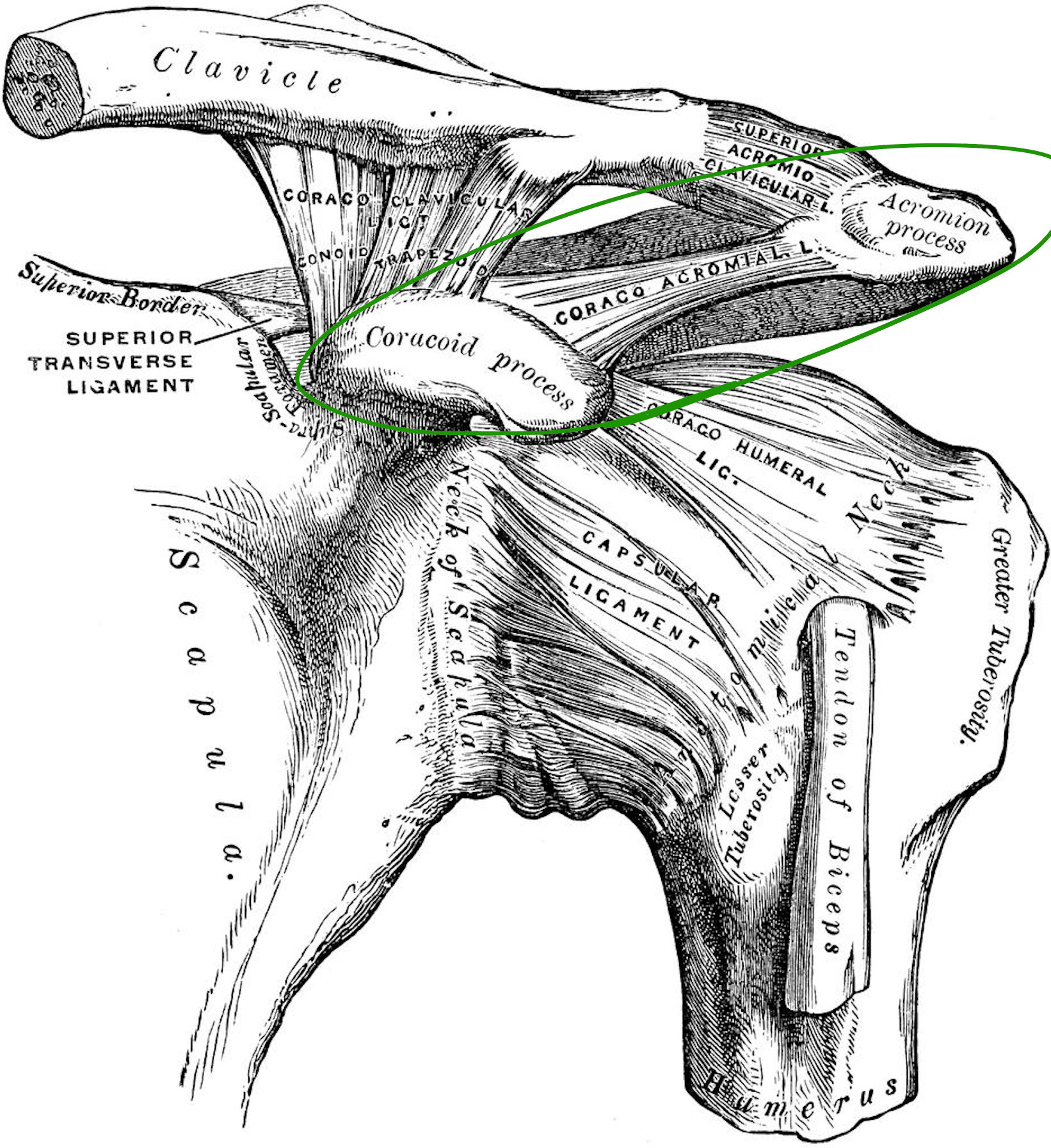
Kirsch focused on the coracoacromial arch, formed by the acromion, coracoid process, and intervening coracoacromial ligament. This structure forms a roof over the rotator cuff and subacromial bursa.
He obtained CT images during simulated overhead hanging, applying approximately 40–60 pounds of traction.
His observations suggested that the proximal humerus could mechanically load the coracoacromial arch in this position.
Kirsch proposed that repeated hanging might gradually stretch and remodel the arch, potentially creating more room for the rotator cuff.
His hypothesis wasn't simply about temporary distraction. It was about producing lasting anatomical adaptation.
It's a fascinating concept, although convincing longitudinal evidence demonstrating permanent remodeling from hanging remains lacking. Kirsch, Shoulder Pain? The Solution & Prevention
But here's where things get interesting.
For decades, subacromial pain has commonly been attributed to mechanical compression of the rotator cuff beneath the acromion.
The logical treatment? Create more space.
This thinking helped drive the widespread use of subacromial decompression surgery.
Yet the evidence has challenged that approach.
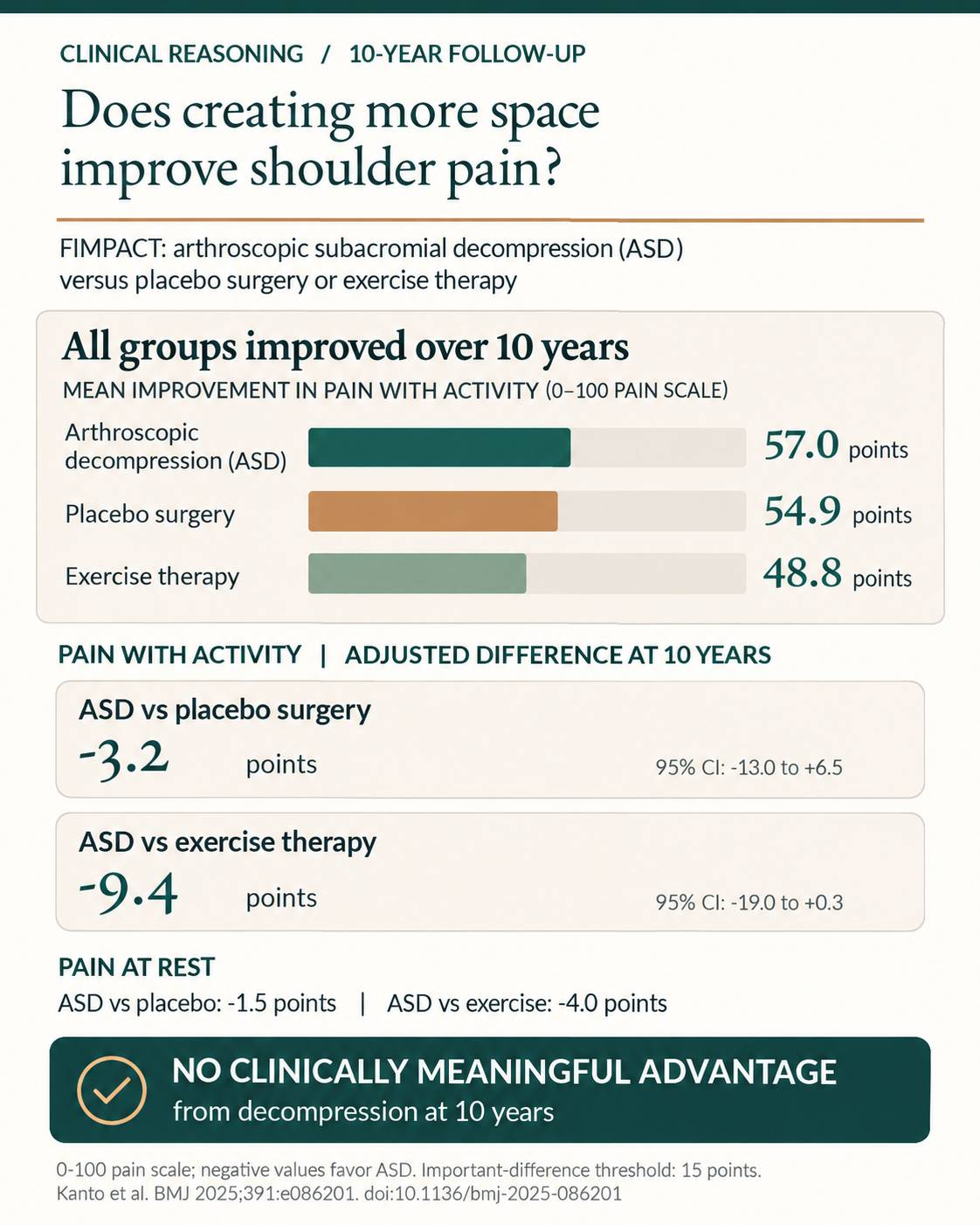
In the FIMPACT randomized trial, investigators compared arthroscopic subacromial decompression with placebo surgery and exercise therapy.
Importantly, the decompression procedure included both acromioplasty and subacromial bursectomy, addressing not only the bony anatomy but also tissue that may contribute to pain.
At 10-year follow-up, patients in all three groups experienced substantial improvement. However, decompression provided no clinically meaningful advantage over either comparison.
The difference in pain with activity between decompression and placebo surgery was just 3.2 points on a 100-point scale, well below the trial's 15-point threshold for clinical importance. Kanto et al., BMJ, 2025
But does the failure of surgical decompression mean that mechanical compression plays no meaningful role in subacromial pain?
I'm not convinced.
What if creating more space isn't enough?
There are at least two ways to interpret these findings.
Perhaps mechanical compression contributes to the development of subacromial pathology, but by the time patients undergo surgery, the underlying tissues have already undergone changes that simply creating more space cannot reverse.
A degenerative supraspinatus tendon doesn't suddenly regain normal collagen architecture because the acromion has been reshaped. And removing bursal tissue doesn't necessarily correct abnormal tendon loading or every contributor to pain.
Alternatively, perhaps mechanical compression isn't the dominant pain generator in many of these patients to begin with.
FIMPACT cannot determine which explanation is correct. The trial excluded full-thickness rotator cuff tears but permitted some partial-thickness pathology, and it wasn't designed to establish whether the severity of preexisting tendon degeneration influenced surgical outcomes. Paavola et al., BMJ, 2018
But here's the distinction I find most interesting: the failure of a procedure designed to create more space doesn't prove that changing how we load the shoulder is unimportant.
Hanging is fundamentally different from acromioplasty.
It exposes the shoulder to sustained overhead positioning, tensile loading, and muscular activity. Its potential benefits may have little to do with permanently enlarging the subacromial space.
Interestingly, an MRI study of 10 asymptomatic shoulders found that the acromiohumeral interval increased from approximately 7.7 mm at 90° of forward flexion to 14.2 mm at 160°. Although this wasn't a study of hanging, it illustrates how dynamic shoulder geometry can be. Roberts et al., Journal of Shoulder and Elbow Surgery, 2002
Perhaps hanging improves overhead mobility, alters tissue loading, or increases tolerance to previously uncomfortable positions.
And perhaps modifying the shoulder's mechanical environment before substantial tissue pathology develops could have preventive value.
These remain hypotheses, but they're worth investigating.
Why I've continued recommending hanging for 10 years
I first wrote about hanging for shoulder health in a fitness magazine back in 2016.
Since then, I've regularly recommended it to appropriately selected patients whose symptoms suggest a subacromial source of pain.
I've seen very encouraging results, particularly among patients who consistently incorporate hanging into their routines.
That experience doesn't establish efficacy. But it's one reason I remain interested in an intervention that has received surprisingly little rigorous clinical investigation.
Kirsch's hanging protocol was fairly specific:
- Grip: Overhand (pronated), with palms facing away.
- Position: Passive hanging, allowing the shoulders to relax and elevate naturally.
- Duration: 10–30 seconds per hang, resting approximately one minute between repetitions.
- Session: Repeated over 10–15 minutes, initially on a daily basis.
- Progression: Full or partial bodyweight, depending on tolerance.
He also recommended lightweight, high-repetition shoulder exercises. Kirsch, Shoulder Pain? The Solution & Prevention
In my practice, I generally recommend several 20–30-second hangs performed regularly. For older patients or those with more significant physical limitations, I'll often begin with supported hanging, keeping the feet in contact with the floor to reduce loading.
Hanging isn't appropriate for every painful shoulder, particularly in patients with instability, acute injury, or significant painful weakness. I also encourage patients not to push through substantial pain.
And it shouldn't replace progressive strengthening and active rehabilitation, which have considerably stronger evidence supporting their use in rotator cuff-related pain. Desmeules et al., JOSPT, 2025
But given its simplicity, accessibility, and the encouraging results I've observed, I think hanging is worth considering as an adjunct for appropriately selected patients with subacromial pain.
The takeaway
I started hanging because I thought my shoulders needed decompression.
A decade later, I'm less certain about the mechanism, but no less interested in the intervention.
Perhaps Kirsch was right about structural remodeling. Perhaps the benefits come from improved mobility, altered tissue loading, or greater tolerance to overhead movement.
We need better studies to know.
But perhaps the more important question isn't whether hanging creates more space. It's whether we're overlooking a simple way to make our shoulders more capable.
And that may be worth considering the next time we're standing beneath a pull-up bar.